
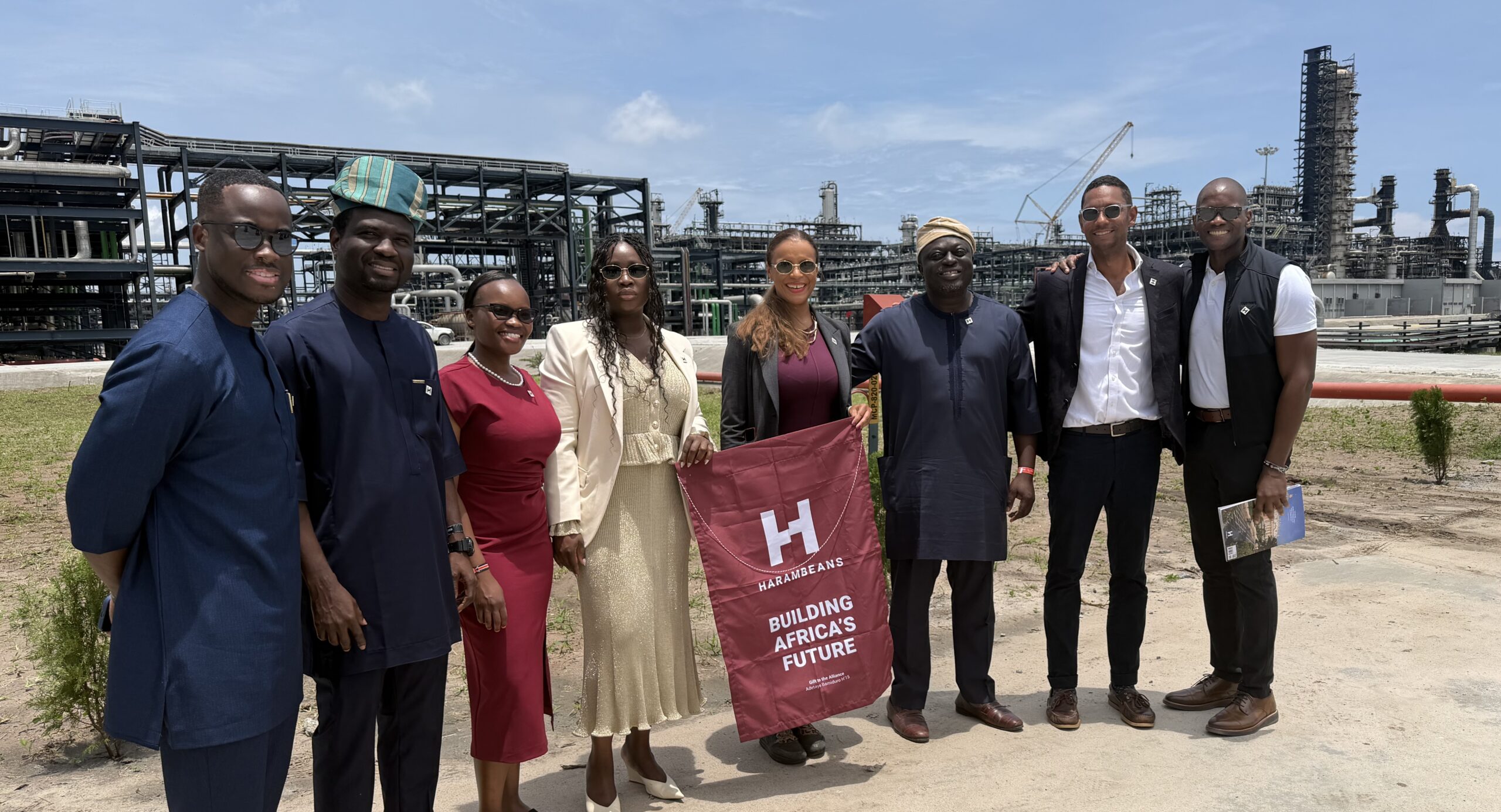
In 2017, we met the entrepreneur. In 2026, we stood inside the institution he had built. As the Harambeans Alliance approaches its 20th anniversary, Dangote’s journey offers us a challenge of our own: what should a network of exceptional people become over the next twenty years?

On September 10, 2026 I stood with a group of Harambeans inside the Dangote Refinery in Lagos. It was one of those moments when the physical scale of an idea becomes impossible to ignore. Nearly a decade earlier, in 2017, we had presented Aliko Dangote with our Malaika Award for Champion of African Entrepreneurship. We were not predicting what Dangote might become. He had already built one of Africa’s great business empires. We were recognising what he had accomplished. Standing inside the refinery this week, I found myself thinking about the distance between those two moments. In 2017, we met the entrepreneur. In 2026, we stood inside the institution he had built.
 That distinction matters as Harambeans approaches its own twentieth anniversary. When we began, our task was relatively simple to describe. We wanted to find exceptional African entrepreneurs and bring them into a community where they could build relationships across borders. We believed Africa did not lack talent. What was missing was trust between people who could build together. We were right about the talent. What we underestimated was what could happen when trust compounds over time.
From Potential to Productive Capacity
In our fireside chat, Dangote himself offered a useful warning about the danger of stopping at potential. “Everybody talks about Africa potential,” he told us. “But unless you put that potential into reality, nothing will happen.”
That is what makes the refinery more than an extraordinary business achievement. Nigeria has enormous oil reserves but historically imported much of the fuel it consumed. Dangote decided that African resources should be matched by African productive capacity, and that industrialization could not simply be left to someone else. The result is not simply another large company. The refinery brings together refining, petrochemicals, storage, power, marine infrastructure and logistics. It creates opportunities for engineers, suppliers and other businesses while changing the productive capacity of the Nigerian economy.
The timing makes the institutional significance harder to miss. Dangote is preparing to take the refinery public in what he calls a “people’s IPO”, seeking at least $1.6 billion while opening ownership of the asset to a much broader pool of investors. The IPO is therefore not simply a financing event. It marks another stage in the evolution of an asset created through concentrated entrepreneurial risk into a broader institutional phase.
Dangote described his ambition plainly: “Our legacy is to industrialize Africa.” But what stayed with me even more was what he said next: “Some other people will even do bigger things going forward.” That is the difference between building a company and building an institution. A company creates value through what it produces. An institution changes the conditions under which other people can create value. The refinery will matter not only for what Dangote produces, but for what others can build because it exists.
That is also the test we should now apply to our Alliance.
What Twenty Years of Trust Have Built
For twenty years, our core insight has been that exceptional entrepreneurs need more than capital. They need relationships of trust across borders. A network can help an entrepreneur meet an investor, find a customer or recruit talent. But over time we learned that the real value was deeper. Technology can make connection almost instantaneous, but connection is not trust, and access to people is not the same thing as the ability to coordinate with them. When trust compounds, relationships begin to function like infrastructure.
We have seen this repeatedly. In 2013, Iyinoluwa Aboyeji H’10 presented an early version of what became Andela at a Harambean gathering at the Harvard Club of New York. Pule Taukobong, then an investment professional at Investec in New York, was in the audience. He was not a Harambean, but invested $10,000 of his own money the next day. He later left Investec to build Africa Angels Network and eventually co founded CRE Venture Capital, which backed Aboyeji again as he built Andela and Flutterwave.
The significance was never the $10,000. It was the chain of effects. A relationship created trust. Trust enabled risk. Risk created opportunity. Opportunity attracted capital. Capital helped build institutions. What began as an encounter within an entrepreneurial ecosystem produced consequences well beyond the original relationship.
We saw something similar when Bright Chinyundu H’21 of BroadPay in Zambia and Andrew Airelobhegbe H’21 of Lenco in Nigeria became roommates at our Bretton Woods Symposium in 2021. Their relationship eventually helped their companies enter each other’s markets, using local licences, knowledge and trust to reduce the friction of cross border expansion. A personal relationship had become market infrastructure.
These experiences have taught us something important about what a network can become. A network effect occurs when the value of a network increases because its members can do more with one another. An institutional effect begins when those capabilities become repeatable and durable, and when people who were not part of the original relationship can benefit from them.
The first twenty years of Harambeans were largely about creating the network effect. The next twenty have to be about creating the institutional effect.
From Network to Entrepreneurial Infrastructure
That means asking a different set of questions. Can the capital accumulated by one generation systematically help finance the next? Can knowledge acquired by one founder travel across generations rather than remain trapped inside an individual career? Can a market opening created through one relationship become a pathway available to many companies? Can the Alliance identify exceptional talent before conventional institutions do, and then provide the capital, expertise and relationships necessary to turn that talent into durable businesses?
In other words, can the Alliance become infrastructure for entrepreneurship rather than simply a network of entrepreneurs?
Our partnership with the Africa Jobs Fund is an early example of what this transition can look like. The Harambeans Africa Jobs Fund Prize is designed to create a pathway from exceptional talent to execution, providing early capital to test opportunities and a larger pool of capital to scale what has been proven. It focuses on opportunities that conventional venture capital often overlooks, including businesses that can build in Africa, sell to the world and create high productivity jobs.
The significance is not simply the money. The model brings together capital, industry expertise and operating support around opportunities that may be too early, unfamiliar or operationally difficult for conventional investors to underwrite. Philanthropic and catalytic capital can take the first risk, help prove the model and create a pathway toward commercial capital.
That is a different kind of institution from the one we started twenty years ago. Instead of simply helping an entrepreneur meet an investor, the Alliance can increasingly help identify an opportunity, find the entrepreneur capable of pursuing it, provide the capital and expertise to test it, and create a pathway for others to follow once the model works.
Our Alliance is becoming infrastructure.
The Challenge of De Risking What Comes Next
There is a striking parallel with Dangote’s own philosophy. He described his role to us as “de risking Africa.” His logic is that somebody has to take the first risk that others consider irrational. Build the factory. Prove the market. Establish the infrastructure. Once the opportunity becomes demonstrably real, other capital can follow.
The same principle applies to entrepreneurship. An investor can wait for certainty, or help create it. A philanthropist can fund another programme, or underwrite an experiment that makes a new market investable. An experienced founder can simply celebrate his own success, or use what he has learned to shorten the path for someone coming behind him.
This is why the next phase of Harambeans cannot be built by founders alone. It requires investors who see the value of backing the ecosystem as well as individual companies, experts willing to share knowledge that would otherwise remain trapped in individual careers, philanthropists willing to absorb risks that commercial capital cannot yet take, partners able to open markets and capabilities, and alumni willing to put their accumulated experience and relationships to work for those coming behind them.
Dangote put another part of the principle simply during our conversation: “We have to believe in ourselves, and we have to also try and be together.”
What Will We Build Together?
That is increasingly how I think about our next twenty years. The question is no longer whether Harambeans can build a powerful network. We have done that. The question is whether we can turn that network into infrastructure that compounds opportunity.
What happens if the capital of the our Alliance follows its talent? If its knowledge travels across generations? If founders become investors, investors become institution builders, philanthropists help prove opportunities that commercial markets are not yet ready to finance, and partners help turn those opportunities into durable businesses? What happens if the success of one Harambean systematically makes the path easier for the next?
There is a temptation, when looking at Dangote, to ask how Africa can produce another Dangote. I think that is the wrong question. The more consequential question for our Alliance is whether we can help create the conditions in which hundreds of ambitious Africans can attempt things that today seem improbable, and in which the success of one makes it easier for the next.
Dangote is building productive infrastructure that can enable others to industrialize. Our opportunity is to build entrepreneurial infrastructure that can enable others to build.
That is the challenge of our next twenty years. It is not simply a challenge to Harambean founders. It belongs to every investor, expert, philanthropist, partner and alumnus gathered under the Harambean aegis, and to generations of Harambeans who have not yet joined us.
Twenty years ago, we set out to find the people who could build Africa’s future.
We found them. Now we have to build what they can build together.
Okendo Lewis-Gayle is founder and Executive Chairman of Harambeans.